
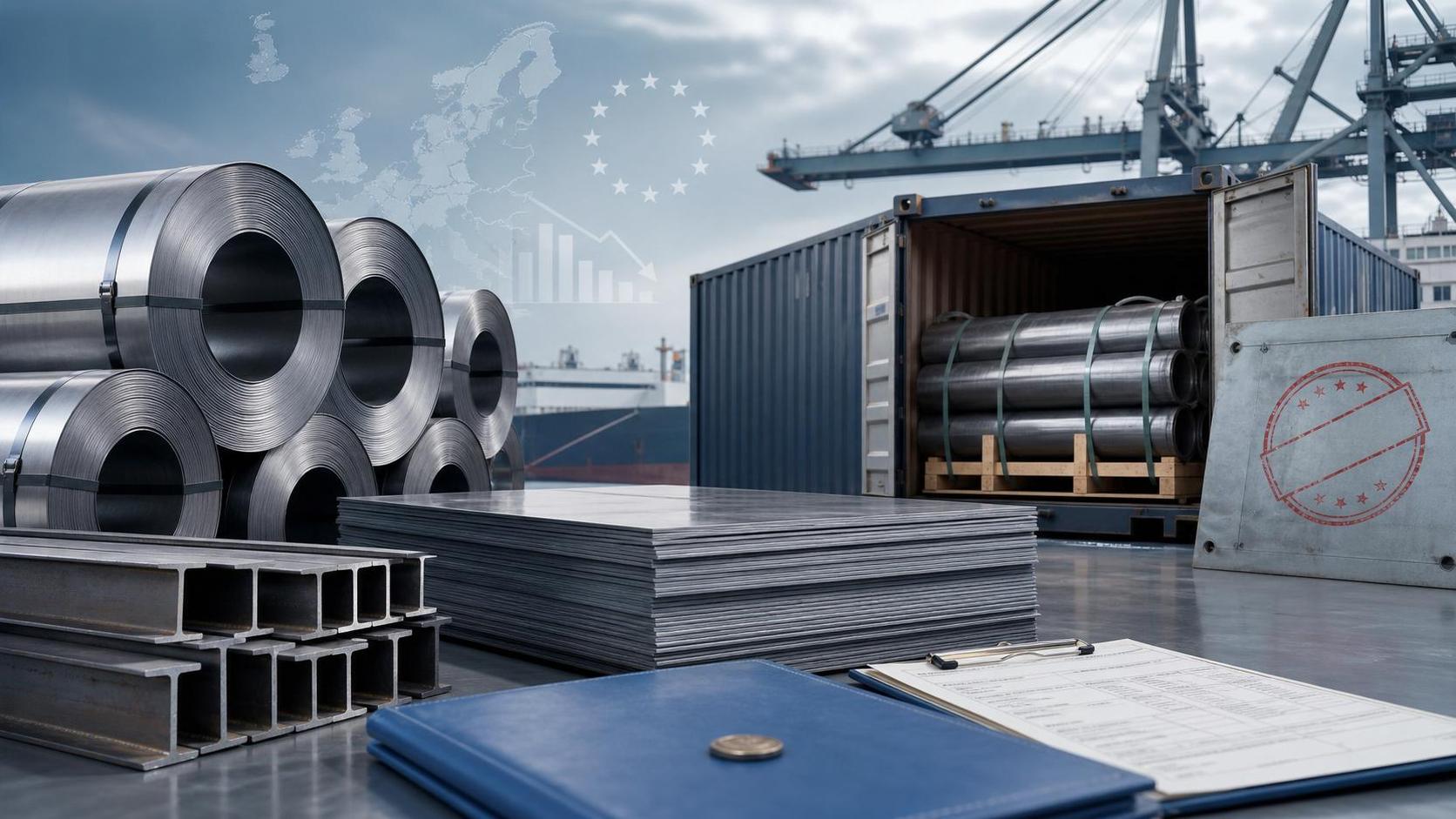
On June 15, 2026, China resumed applications for steel export licenses, while a new EU steel import quota mechanism is set to take effect on July 1. Taken together, these two rule changes directly affect exporters, overseas importers, procurement teams, and customs-facing supply chain operations, because license status now becomes a practical condition for export declaration from China and a key factor in assessing tariff exposure and sourcing choices for steel shipments headed toward the EU market.
What Has Changed in the Trade Framework
According to the information provided, China has fully resumed the application process for steel export licenses from June 15, 2026. The first batch of licenses is focused on higher value-added new steel products, including weathering steel, fine blanking steel, and high-strength structural steel.
The same information states that this move is intended to align with a new round of EU steel import quotas effective from July 1. Under that mechanism, the overall quota volume is reduced by 47%, and Chinese ordinary steel without an export license faces an additional 50% tariff.
It is also confirmed that the policy has a direct impact on customs clearance compliance for overseas importers and on procurement route selection. Orders without a valid export license will not be able to complete export customs declaration in China.
Where the Immediate Pressure Falls
Export transactions now depend on document readiness
For exporting companies, the change is not only about market access but also about whether a shipment can move at all. The confirmed rule that orders without a valid export license cannot complete China export customs declaration means documentation becomes an operational checkpoint rather than a later-stage formality.
From an industry perspective, what deserves closer attention is the sequencing between product classification, license application, and shipment booking. Where cargo falls outside the initially prioritized higher value-added steel categories, businesses may need to pay closer attention to whether order planning and export filing remain aligned with the new compliance path.
Overseas buyers face a tighter procurement filter
For overseas importers and procurement teams, the combined effect of a lower EU quota and an additional 50% tariff on unlicensed Chinese ordinary steel changes the screening logic for suppliers and orders. Analysis shows that procurement decisions are likely to depend more heavily on whether the supplier can present valid export licensing status before shipment, not only on price or lead time.
This also affects customs compliance review on the buyer side. Even where a transaction remains commercially attractive, the absence of valid licensing can turn into a clearance or landed-cost problem.
Supply chain service providers need closer file coordination
Freight forwarders, customs brokers, and other supply chain service providers may also feel the impact because shipment release now depends more directly on document completeness. Observably, the practical risk is not limited to tariffs; it also extends to delayed declarations, booking adjustments, and disruptions in the handoff between seller, logistics provider, and importer.
For these participants, the critical issue is whether export documents, product descriptions, and customs filing materials stay consistent with the new licensing requirement.
What Companies Should Review Now
Check whether product scope matches license eligibility
Analysis shows that companies involved in steel exports or cross-border sourcing should first review whether their products fall within the categories receiving initial attention, such as weathering steel, fine blanking steel, and high-strength structural steel. This is not the same as assuming broader product coverage, and the current information should be read cautiously.
Reassess order documentation before shipment
Because unlicensed orders cannot complete export customs declaration in China, contract execution now depends more directly on document timing and filing readiness. Businesses may need to review whether purchase orders, product specifications, customs documents, and shipment arrangements are prepared in a way that matches the licensing requirement.
Watch tariff exposure alongside supplier qualification
For buyers targeting the EU market, the new quota regime should not be assessed separately from supplier compliance. It is more appropriate to understand this as a combined trade control signal: license status, product category, and tariff exposure now interact more closely in sourcing decisions.
Track follow-up wording and implementation signals
The provided information confirms the main policy direction, but it does not include detailed implementation language beyond the core requirements described above. From an industry perspective, companies should continue watching for further official wording, execution standards, document expectations, and any changes that may appear in trade paperwork or procurement requirements.
Why This Looks Like an Execution Signal
Analysis shows that this development is better understood as an active compliance signal rather than a purely symbolic policy adjustment. One part of the change has already taken effect on June 15 through the resumption of export license applications, while the next part arrives on July 1 through the EU quota tightening.
At the same time, it would be premature to treat all downstream outcomes as settled. Observably, the market still needs to see how licensing priorities, procurement responses, and customs-facing execution play out in practice. That is why continued attention to rule interpretation and transaction-level implementation remains necessary.
How the Market Should Read This Stage
At this stage, the clearest takeaway is that steel trade involving China and the EU is moving into a more document-sensitive and rule-dependent operating environment. The confirmed facts point to immediate relevance for export declaration, buyer compliance screening, and procurement route selection.
It is more appropriate to understand this development as a rule change with real operational consequences that has started to land, while some execution details still require observation. For businesses in the chain, the near-term focus is less about broad market prediction and more about whether orders, product categories, and compliance documents can withstand the new trade conditions.
Basis of This Article and What Still Needs Verification
This article is generated based on the user-provided news title, event date, and event summary. For events of this kind, commonly relevant source categories may include official notices, regulator releases, customs or trade authority information, industry association updates, standard-setting documents, and reporting by authoritative media.
No specific official source link was provided in the input, so the exact official publication path still needs to be verified on an ongoing basis. Further observation is also needed regarding detailed policy language, implementation standards, procurement document changes, market feedback, and how companies carry the new requirements into actual export and import operations.

Fill in the information
NOW.
Our staff will contact you as soon as possible