
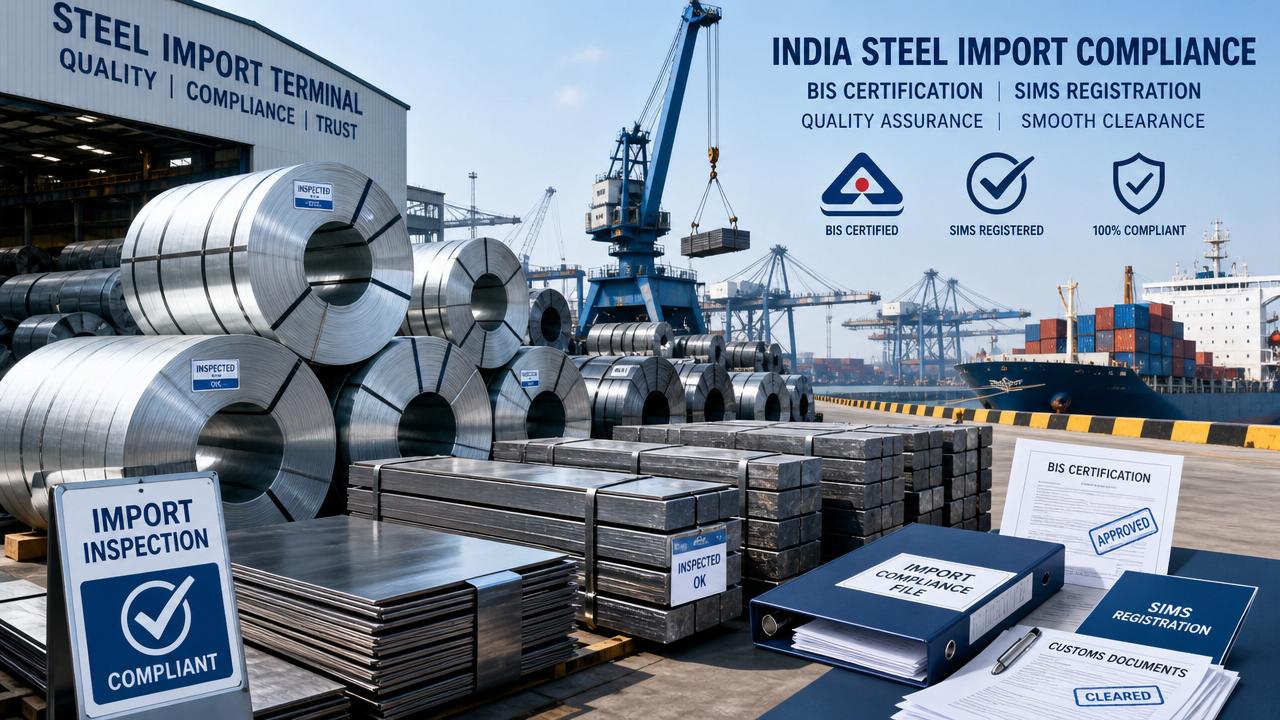
India’s steel import regime changed on June 13, 2026, when the Ministry of Steel formally introduced a rule requiring imported finished steel products and the raw materials used to produce them to meet BIS certification requirements and complete SIMS registration. For importers, distributors, processors, procurement teams, and supply chain service providers, the development matters not only because of the compliance threshold itself, but because it can directly affect customs timing, documentation readiness, sourcing choices, and delivery planning.
What the new import requirement formally covers
According to the information provided, the Ministry of Steel in India officially issued the new rule on June 13, 2026. The rule requires that, for bills of lading dated from June 16, 2024, all imported finished steel products and raw materials used in their production, including items such as billets and slabs, must comply with Bureau of Indian Standards (BIS) certification requirements. The same imports must also complete registration under the Steel Import Monitoring System (SIMS).
The information provided also states that the rule raises the compliance threshold for steel imports, with a particular impact on importers and distributors involved in further-processed steel products.
Where the pressure is likely to appear first
Imports tied to further processing face tighter entry conditions
From an industry perspective, companies importing steel for downstream processing may feel the change more directly because the rule does not stop at finished steel alone and also reaches production inputs such as billets and slabs. That means compliance checks may need to begin earlier in the sourcing chain, not only at the point of final product importation.
What deserves closer attention is whether import documentation, certification readiness, and shipment timing remain aligned. Where BIS certification or SIMS registration is incomplete, the risk is less about a theoretical rule change and more about practical disruption in import handling and delivery schedules.
Distributors may need to reassess tradable inventory
For distributors, the issue is not just whether goods can be purchased, but whether the products entering the market meet the required certification and registration conditions. Analysis shows that this can affect stocking decisions, product turnover, and the commercial usability of imported material, especially where products have already been positioned for resale into time-sensitive projects.
Distributors should pay particular attention to product traceability, import document completeness, and whether supplier-provided compliance materials are sufficient for customs and downstream customer review.
Procurement and supply chain functions may need earlier controls
For procurement teams and supply chain coordinators, the new rule shifts compliance review closer to the front end of ordering decisions. Observably, if steel inputs and finished products both fall within the certification and registration framework, purchase planning may need to account for additional verification steps before shipment rather than after arrival.
The operational concern here is straightforward: if compliance status is not confirmed early, the result may be delayed clearance, extra certification-related cost, or a need to reset supplier arrangements.
What companies should examine now
Check certification status at product and material level
Analysis shows that companies should not limit their review to finished steel items alone. Because the rule also applies to production raw materials, businesses should verify whether the imported item itself and the upstream material category involved in production are both covered by the required BIS framework.
Review SIMS readiness alongside shipment documents
It is more appropriate to understand SIMS registration as part of the practical import compliance package rather than a secondary formality. Companies should therefore compare shipment records, bill of lading dates, registration status, and supporting compliance files to identify gaps before goods move into customs procedures.
Revisit supplier qualification and delivery commitments
Where imports depend on suppliers that may not yet be fully aligned with BIS-related requirements, procurement and sales teams should review whether promised lead times and delivery commitments still remain realistic. The key point is not that disruption is certain, but that supplier qualification may now play a larger role in delivery reliability.
Watch for execution language and market response
The information provided does not include detailed enforcement guidance, so companies should continue monitoring how the rule is described in official wording, trade-facing procedures, tender documents, and practical market communication. This is especially relevant for businesses handling further-processed steel and imported feedstock.
Why this looks like an execution signal, not just a headline
As an editorial observation, this development is more appropriately understood as a concrete compliance signal rather than a general policy discussion. The reason is that the requirement is tied to both BIS certification and SIMS registration, and it applies across finished products and production raw materials. That combination suggests the market should focus on execution readiness, not only on policy interpretation.
At the same time, analysis also suggests that the full commercial effect still requires observation. The eventual impact on clearance timing, cost absorption, sourcing adjustments, and customer delivery expectations will depend on how the rule is applied in practice and how quickly market participants adapt.
How the market may best read the change for now
At this stage, the most balanced reading is that India’s June 13 steel import rule marks a real tightening of import compliance conditions for steel products and related production materials. It should not be treated as a routine administrative update, yet it is also too early to reduce it to a single market outcome. For industry participants, the practical task now is to follow certification scope, registration handling, shipment documentation, and supplier alignment with greater discipline while watching how implementation develops.
Basis of this article and what still needs verification
This article is generated based on the user-provided news title, event date, and event summary. For developments of this kind, commonly relevant source categories may include official announcements, regulator releases, customs or trade administration information, industry association updates, standards organization documents, and reporting by authoritative media.
No specific official source link was provided in the input, so the exact official reference still requires follow-up verification. What remains worth monitoring includes detailed implementation language, certification interpretation, changes in tender or procurement documents, market feedback, and how companies are handling the rule in actual trade and delivery operations.

Fill in the information
NOW.
Our staff will contact you as soon as possible