

On June 14, 2026, execution began for a strategic steel procurement program tied to the Kyrgyzstan section of the China-Kyrgyzstan-Uzbekistan railway, turning a large cross-border order into a practical test of export rules rather than a routine sales update. What makes this development worth industry attention is not only the order size, but the clear operating requirements attached to it: GB/T compliance, third-party inspection reporting, a 90-day delivery window, and immediate pressure on exporter qualifications, customs compliance, production scheduling, and logistics coordination across the supply chain.
The Order Has Moved From Intention to Execution
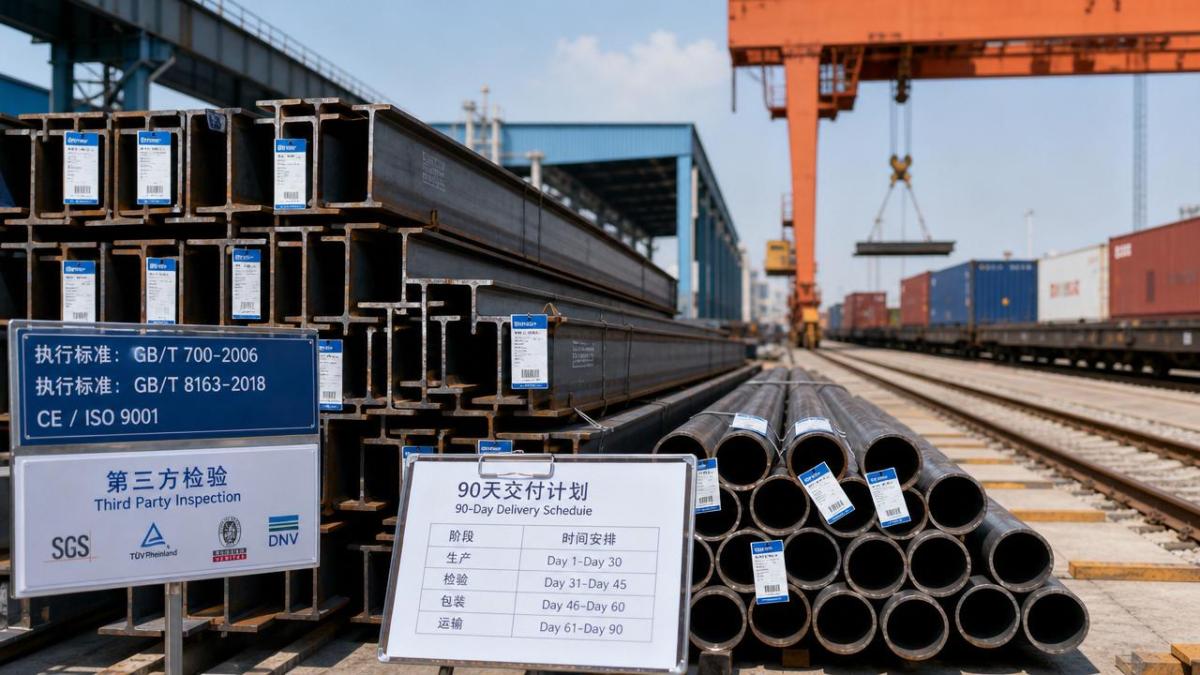
According to the provided event summary, the strategic procurement project for the Kyrgyzstan section formally entered the execution stage on June 14, 2026. The first batch totals RMB 1.6 billion and covers 45,700 tons of I-beams, 6,700 tons of H-beams, and 18,600 tons of seamless steel pipe.
The confirmed technical and trade requirements are also clear. All products in this first batch must meet Chinese national standards, identified as GB/T, and must be accompanied by third-party inspection reports. The project is described as a landmark engineering program linked to RCEP and Central Asia connectivity, with delivery locked within 90 days.
The summary further states that rigid requirements now apply to exporter qualifications, capacity scheduling, customs declaration compliance, and logistics coordination. It also indicates that overseas distributors and importers need to connect immediately with Chinese direct suppliers of steel sections that have customs clearance experience in Central Asia.
Where the Compliance Pressure Now Falls
Specification control is moving upstream to mills and processors
From an industry perspective, manufacturers and processors of I-beams, H-beams, and seamless pipe are among the first to feel the effect because the order does not leave room for loose specification matching. The stated GB/T requirement and the need for third-party inspection reports mean that production, testing, and document preparation have to be aligned before shipment rather than adjusted later in the transaction cycle.
For these suppliers, the main impact is likely to appear in technical documentation, batch traceability, inspection readiness, and production sequencing within the 90-day window. What deserves closer attention is whether each shipment set can demonstrate standard conformity in a way that supports both customer acceptance and export documentation review.
Export traders face stricter execution risk, not just sales opportunity
Direct export companies are affected because the summary explicitly links project execution to exporter qualifications and customs declaration compliance. This suggests that participation is no longer only about access to product supply, but also about whether the exporter can manage document accuracy, declaration consistency, and delivery coordination under a fixed schedule.
Analysis shows that the practical pressure point for traders lies in contract execution discipline: product descriptions, standards references, inspection files, shipping data, and customs paperwork all need to work together. Any mismatch between commercial documents and technical evidence could become a delivery or clearance problem rather than a simple administrative correction.
Distributors and import-side buyers must prioritize clearance capability
Overseas distributors and importers are directly named in the event summary, which makes their role especially important. The immediate call to engage Chinese direct suppliers with Central Asia customs clearance experience indicates that channel selection is becoming a compliance decision as much as a sourcing decision.
For these market participants, the main impact is likely to center on supplier screening, clearance coordination, and timing control. Observably, import-side planning now depends not only on price and availability, but also on whether the chosen supplier can support document flow and border execution in a commercially usable timeframe.
Inspection and logistics service providers become part of delivery eligibility
Third-party inspection bodies and supply chain service providers may also be affected because the transaction conditions elevate their role from support function to delivery prerequisite. The inspection report is not presented as optional, and logistics coordination is described as a rigid requirement.
That means service providers involved in testing, cargo preparation, and transport coordination may be judged by whether they can keep paperwork, cargo movement, and delivery deadlines synchronized. In practice, this can reshape how exporters choose external partners for project cargo tied to regulated specification and timing requirements.
What Companies Should Review Immediately
Check whether GB/T compliance files are transaction-ready
Companies targeting this project or similar orders should first review whether product specifications, mill documentation, and third-party inspection materials are ready to support export execution. The key issue is not merely claiming GB/T alignment, but being able to present it in a form that can travel through procurement review, shipment release, and customs processes.
Reassess whether the 90-day window fits actual production and dispatch plans
The fixed delivery cycle makes capacity planning a front-end issue. Analysis shows that suppliers and traders should pay close attention to whether existing production slots, packaging schedules, inland transport, and export booking arrangements can support timely fulfillment without creating compliance gaps or documentation shortcuts.
Screen export and clearance partners by operational experience
The event summary specifically highlights the need to work with Chinese direct suppliers that have Central Asia customs clearance experience. It is more appropriate to understand this as a practical execution threshold. Companies on the buy side and sell side should therefore review partner qualifications, document handling capability, and coordination experience before committing to shipment schedules.
Keep tender and technical files under active review
The provided information confirms core requirements, but does not provide full downstream execution detail. For that reason, businesses should continue watching for changes in technical bid alignment, documentation expectations, inspection wording, and transaction-level delivery instructions. These points should be treated as active review items rather than assumed settled procedures.
Why This Looks Like an Execution Signal, Not Just a Project Update
Analysis shows that this development is more meaningful as an execution signal than as a simple project milestone. The confirmed combination of GB/T standards, third-party inspection, strict delivery timing, exporter qualification requirements, and customs compliance expectations suggests that market access for this order is being defined by operational readiness.
Observably, the event does not by itself establish a new published regulation in the formal sense based on the information provided. However, it does show how procurement-linked rules can function as binding market requirements once a project enters execution. That is why steel exporters, inspection partners, logistics providers, and overseas channel participants should treat this as a live compliance and delivery benchmark while still monitoring how the requirements are applied in practice.
How the Market May Best Read This Development
From an industry perspective, the most balanced reading is that this order marks the practical landing of project-specific trade and compliance requirements in a major cross-border infrastructure context. It confirms that standard conformity, third-party verification, schedule control, and clearance capability are central to participation in the first shipment cycle.
It is more appropriate to understand this as a concrete execution-stage change with immediate operational consequences, while also recognizing that the finer points of implementation may still need observation through subsequent tender documents, shipment practice, and market feedback. In that sense, the event matters less as a broad narrative about demand and more as a near-term test of how exporters and supply-chain partners meet documented requirements under time pressure.
Basis of This Article and What Still Needs Verification
This article is generated from the user-provided news title, event date, and event summary. No specific official source link was provided in the input, so any formal source documentation still requires ongoing verification.
For events of this type, commonly relevant source categories may include official project notices, regulatory releases, customs or trade authority information, industry association updates, standard-setting documents, tender materials, and reporting from authoritative media. What still needs continued observation includes any further execution details, certification interpretation, tender document updates, customs practice, and industry feedback from participating companies and service providers.

Fill in the information
NOW.
Our staff will contact you as soon as possible